
Concept proposal · adjective · post-generative
Post-Generative
Educational Technology, Graz University of Technology, Austria
Everyday life permeated by generative AI.
Post-generative describes a societal condition in which generative artificial intelligence permeates everyday life. It shapes how people work, learn, communicate, design and produce knowledge. Its outputs enter the information, tools and environments we encounter every day, affecting even those who do not consciously use it. [1] Human and machine contributions become intertwined and increasingly difficult to distinguish. AI outputs are increasingly adopted or passed on without people reviewing them individually. The volume and speed of generation can overwhelm human oversight. At the same time, new dependencies emerge: whoever controls AI systems shapes access to knowledge and participation. Drawing on the idea of the post-digital [2], the post-generative describes a world already transformed by generative AI, whose possibilities, expectations and conflicts it helps to shape.
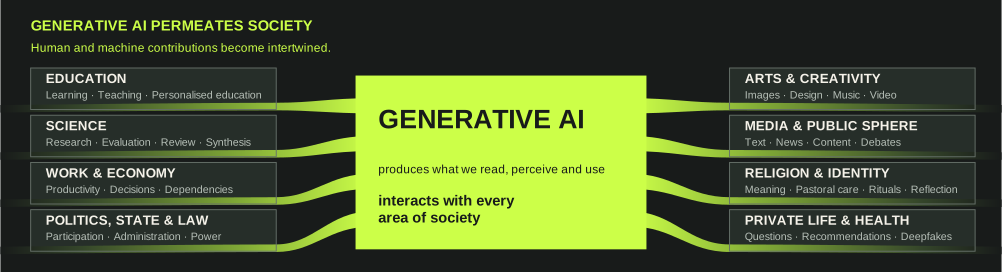
- Education — Learning · Teaching · Personalised education
- Science — Research · Evaluation · Review · Synthesis
- Work & Economy — Productivity · Decisions · Dependencies
- Politics, State & Law — Participation · Administration · Power
- Arts & Creativity — Images · Design · Music · Video
- Media & Public Sphere — Text · News · Content · Debates
- Religion & Identity — Meaning · Pastoral care · Rituals · Reflection
- Private Life & Health — Questions · Recommendations · Deepfakes
Adoption
Twelve indications of a post-generative present
All indications →The poster supports the term with twelve findings from education, science, software development, politics, the arts and religion. Each indication shows one facet of the post-generative present and has its own page in the archive.
- 01
 Student life changes. No. 001
 - 02
 Understanding matters. No. 002
 The Association for Human Mathematics criticises OpenAI’s AI-generated mathematical results. Heise reported on the conflict over human understanding and scientific norms. Contextualising and checking matter more than mere generation. [9]
- 03
 Evidence of learning changes. No. 003
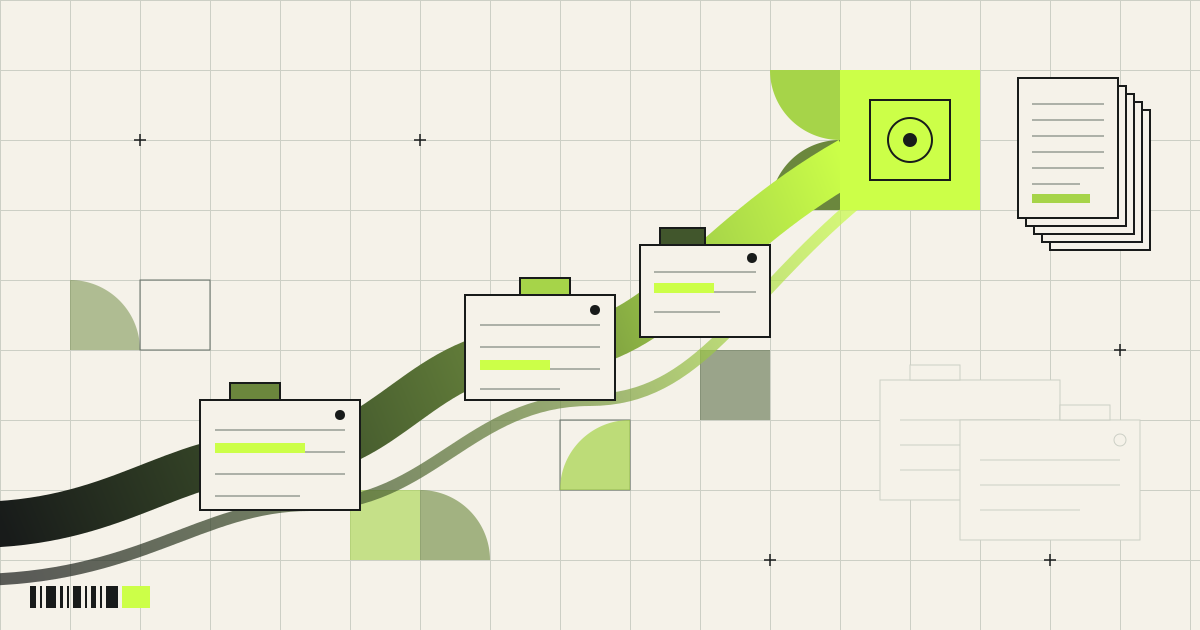
 FHWien / Kroop (2026): an experimental approach to master’s theses centres on process, traceable decisions and verifiable artefacts. Academically convincing text alone becomes a less reliable sign of understanding. [10] Process and accountability matter more.
- 04
 Apps need only an idea. No. 004
 - 05
 Software can be generated. No. 005
 Artcraft: a developer uses AI to build open-source Adobe alternatives. Still an early alpha with missing and broken features. derStandard.at reports on emerging possibilities in software development. [13]
- 06
 Review cannot keep pace. No. 006
 - 07
 Software on the fly. No. 007
 OpenAI’s Intelligent UI [17] already generates interactive calculators, games and interfaces right within a conversation: tools emerge at the moment of need but can create new dependencies. Our thesis: everyday life is increasingly situated co-generated.
- 08
 AI joins the cabinet. No. 008
 Since 2025, Albania has used the virtual minister “Diella” for public procurement. ORF reports investigations against its operators, a constitutional challenge and a lawsuit by the actress whose face and voice were used. [18]
- 09
 AI helps with knowledge reviews. No. 009
 Wagner et al. (2026) describe AI-assisted literature reviews: summarising, extracting and answering questions. Their methods paper discusses opportunities and risks for scholarly knowledge work. [19] Critical review becomes a key skill.
- 10
 Creatives push back. No. 010
 Creative Bloq reports protests from the Blender community against OpenAI’s advertising. The artist whose work appears in the advert voices outrage. Generation reshapes disputes over creative work. [20]
- 11
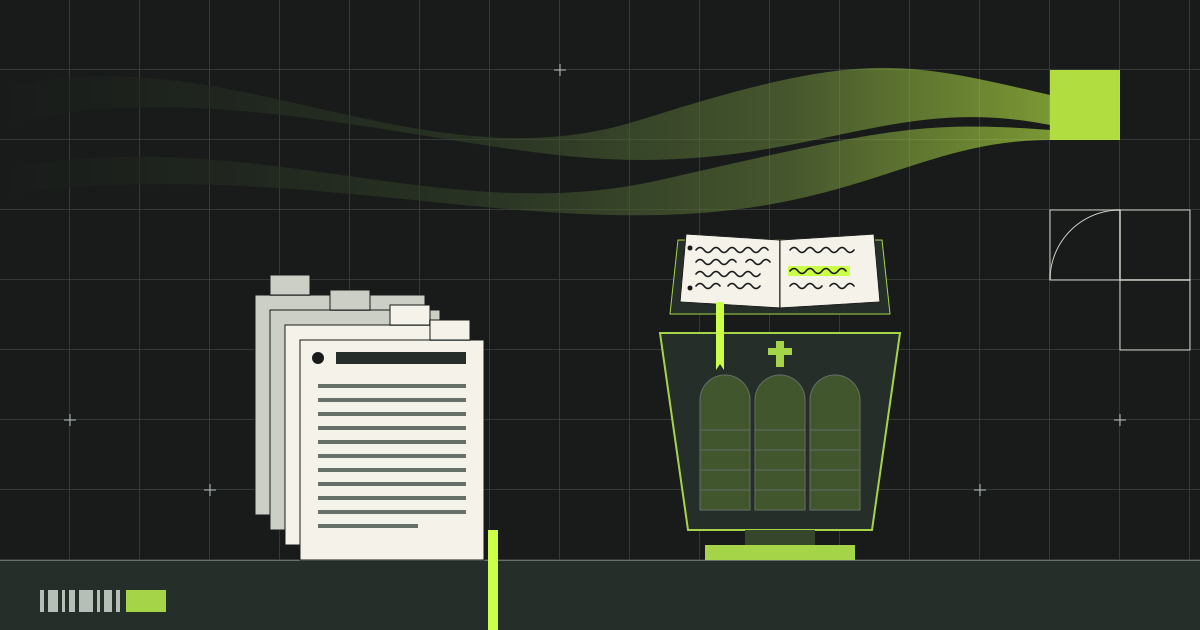 The Church draws lines. No. 011
 According to media reports, Pope Leo XIV warned the priests of his Diocese of Rome against having AI write their sermons. AI cannot pass on faith, he said, and thinking, too, needs exercise. [21]
- 12
 AI develops AI. No. 012
 Chan et al. (2026) ask whether automated AI research could trigger an intelligence explosion. The Cambridge paper describes a possible acceleration mechanism and its risks. A future scenario, no proof of present ubiquity. [22]
Read on
Many more recent findings and personal statements
Downloads
Version: 9 October 2026 · DOI: 10.3217/5yw6c-40a39Sources [1]–[22]
- [1] Liang, Weixin; Zhang, Yaohui; Codreanu, Mihai; Wang, Jiayu; Cao, Hancheng; Zou, James (2025): The widespread adoption of large language model-assisted writing across society. Patterns, 6(12), 101366. Online 2 October 2025. Preprint: arXiv:2502.09747. doi.org/10.1016/j.patter.2025.101366 (opens in a new tab) · doi:10.1016/j.patter.2025.101366 (opens in a new tab)
- [2] Cramer, Florian (2014): What Is ‘Post-Digital’?. A Peer-Reviewed Journal About, 3(1), 10-24. aprja.net/article/view/116068 (opens in a new tab) · doi:10.7146/aprja.v3i1.116068 (opens in a new tab)
- [3] Kyoto University, Graduate School of Informatics (2025): ポスト生成AI共生社会の展望〜集中、分散、そして第三の道〜. Japanese announcement of 5 September 2025; symposium on 8 October 2025. www.i.kyoto-u.ac.jp/topics/2193 (opens in a new tab)
- [4] Kyoto University, Institute for the Future of Human Society (2025): IFOHS Prof. Uchida to Join Symposium on “Prospects for a Post-Generative AI Inclusive Society: Centralization, Decentralization, and a Third Way”. English event news, 8 October 2025. ifohs.kyoto-u.ac.jp/en/archives/36827 (opens in a new tab)
- [5] Eurostat (2025): 32.7% of EU people used generative AI tools in 2025. EU survey on ICT usage in households and by individuals; published 16 December 2025. Dataset isoc_ai_iaiu. ec.europa.eu/eurostat/web/products-eurostat-news/w/ddn-20251216-3 (opens in a new tab)
- [6] Chatterji, Aaron; Cunningham, Thomas; Deming, David J.; Hitzig, Zoe; Ong, Christopher; Shan, Carl Yan; Wadman, Kevin (2025): How People Use ChatGPT. NBER Working Paper 34255, September 2025. www.nber.org/papers/w34255 (opens in a new tab) · doi:10.3386/w34255 (opens in a new tab)
- [7] Nagler, W.; Mayr, B.; Ebner, M.; Schön, S.; Bruenner, B. (2026): Digital Equipment Evolution and IT Activity of TU Graz study beginners (2011-2025): Challenges of Tablet and AI Dominance for University Digital-Sovereignty Initiatives. Proceedings of EdMedia 2026 Edinburgh, pp. 119-129. AACE, Waynesville, NC. www.learntechlib.org/primary/p/2129631/ (opens in a new tab)
- [8] Klopfer, Eric; Madden, Sam (Co-Chairs); MIT Ad Hoc Committee on AI Use in Teaching, Learning, and Research Training (2026): AI and Education: Report of MIT’s Ad Hoc Committee on AI Use in Teaching, Learning, and Research Training. Massachusetts Institute of Technology, final report, 13 August 2026. aiandeducation.mit.edu/report/ (opens in a new tab)
- [9] Holland, Martin (2026): „Haben nicht darum gebeten“: Scharfe Kritik an OpenAI aus der Mathematik. heise online, 8 October 2026. www.heise.de/news/KI-generierte-Mathematikloesungen-Scharfe-Kritik-am-Vorgehen-von-OpenAI-11480767.html (opens in a new tab)
- [10] FHWien der WKW (2026): Mehr Prozess, weniger Seiten: Masterarbeiten im KI-Zeitalter neu gestalten. Campus blog & news, 10 July 2026. www.fh-wien.ac.at/news/mehr-prozess-weniger-seiten-masterarbeiten-im-ki-zeitalter-neu-gestalten/ (opens in a new tab) · doi:10.1007/978-3-032-28570-6_19 (opens in a new tab)
- [11] Meyer, Jesse G. (2025): Rapid Development of Omics Data Analysis Applications through Vibe Coding. arXiv:2510.09804, version 1, 10 October 2025. arxiv.org/abs/2510.09804 (opens in a new tab) · doi:10.48550/arXiv.2510.09804 (opens in a new tab)
- [12] Wang, Tonghe; Beaudry, Joel; Damato, Antonio L.; Kollmeier, Marisa; Aramburu Núñez, David (2026): AI-assisted software development for brachytherapy seed inventory management. Journal of Applied Clinical Medical Physics, 27(9), e70795. 9 September 2026. aapm.onlinelibrary.wiley.com/doi/10.1002/acm2.70795 (opens in a new tab) · doi:10.1002/acm2.70795 (opens in a new tab)
- [13] Proschofsky, Andreas (2026): Von Adobe genervter Entwickler baut Photoshop, Premiere und Co mit KI als Open Source nach. derStandard.at, 8 October 2026. www.derstandard.at/story/3000000343256/von-adobe-genervter-entwickler-baut-photoshop-premiere-und-co-mit-ki-als-open-source-nach (opens in a new tab)
- [14] Torvalds, Linus (2026): Linux 7.1-rc4. Linux Kernel Mailing List, 17 May 2026. lkml.org/lkml/2026/5/17/896 (opens in a new tab)
- [15] Stenberg, Daniel (2026): High-Quality Chaos. Blog of the curl founder and maintainer, 22 April 2026. daniel.haxx.se/blog/2026/04/22/high-quality-chaos/ (opens in a new tab)
- [16] Kalz, Marco (2024): A plagiarised edtech book and nobody cares. Personal blog (kalz.cc), 8 March 2024. kalz.cc/2024/03/08/a-plagiarised-edtech-book-and-nobody-cares/ (opens in a new tab)
- [17] OpenAI (2026): GPT-6 und Intelligent UI für alle. Product announcement, 7 October 2026. openai.com/de-DE/index/gpt-6-for-everyone/ (opens in a new tab)
- [18] ORF.at (2026): Korruption in Albanien: Fehlgeleitete KI-Ministerin vor Gericht. ORF.at, 26 May 2026. orf.at/stories/3431001/ (opens in a new tab)
- [19] Wagner, Gerit; Prester, Julian; Mousavi, Reza; Lukyanenko, Roman; Paré, Guy (2026): Generative Artificial Intelligence for Literature Reviews. Journal of Information Technology, 02683962261425675. Also arXiv:2605.16475, 15 May 2026. arxiv.org/abs/2605.16475 (opens in a new tab) · doi:10.1177/02683962261425675 (opens in a new tab)
- [20] Creative Bloq (2026): OpenAI's controversial ChatGPT-6 Astra advert paints a sad vision of the future. Creative Bloq, 6 September 2026. www.creativebloq.com/ai/even-just-the-advert-for-chatgpt-6-astra-is-creating-controversy (opens in a new tab)
- [21] Erzdiözese Wien (2026): Papst Leo XIV.: Priester sollen Predigten nicht von KI schreiben lassen. erzdioezese-wien.at, 20 February 2026. www.erzdioezese-wien.at/portal/archiv/article/136314.html (opens in a new tab)
- [22] Chan, Alan; Winter, Christoph; Barto, Andrew; et al. (2026): What if automating AI R&D triggers an intelligence explosion?. Cambridge Programme on AI Science & Policy, University of Cambridge. casp.ac/reports/intelligence-explosion (opens in a new tab)